Best Employee Time Tracking Software: A Strategic Buyer’s Guide for Modern Businesses

Managing employee time has become one of the most critical challenges for modern organizations. With remote and hybrid teams, flexible schedules, multiple projects, and tighter margins, businesses can no longer rely on assumptions or manual tracking methods. For today’s leaders, the search for the best employee time tracking software is not about monitoring employees, it’s about gaining operational clarity. Accurate time data supports better payroll decisions, realistic project costing, transparent client billing, and long-term productivity improvements. The right approach to time tracking turns hours worked into actionable business intelligence.
Why Time Tracking Is No Longer Optional
Time tracking has evolved far beyond basic clock-in and clock-out systems. Businesses now depend on time data to answer strategic questions such as:
- Are projects actually profitable?
- Where is team capacity being overused or underutilized?
- Are billable hours accurately captured?
- How does remote work impact productivity patterns?
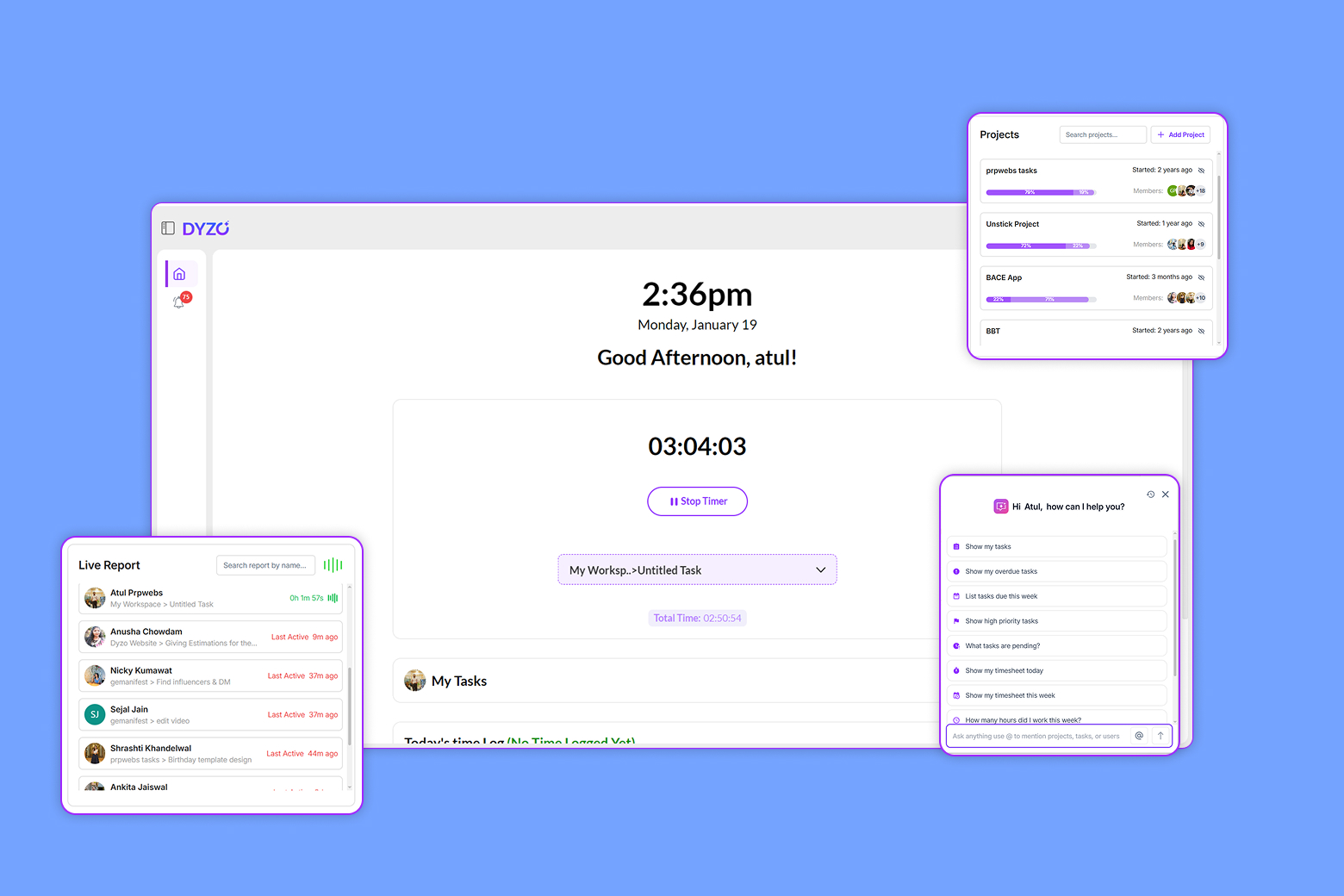
At Dyzo.ai, we consistently see that organizations struggling with growth often lack visibility, not effort. Without reliable time insights, leaders are forced to make decisions based on estimates rather than evidence. This is why selecting the right time tracking tool is a foundational decision for sustainable operations.
The Strategic Selection Framework: How to Choose the Right Software
Instead of chasing feature checklists, businesses should evaluate time tracking solutions through a structured decision framework. This approach ensures the software aligns with real operational needs.
1. Core Tracking Modes: Manual vs Automated
The first consideration is how time is recorded. Manual (Timer-Based) Tracking
- Employees start and stop timers
- Simple and transparent
- Relies heavily on user consistency
Automated / AI-Powered Tracking
- Time is captured automatically based on activity or workflows
- Reduces manual effort
- Improves accuracy for knowledge-based work
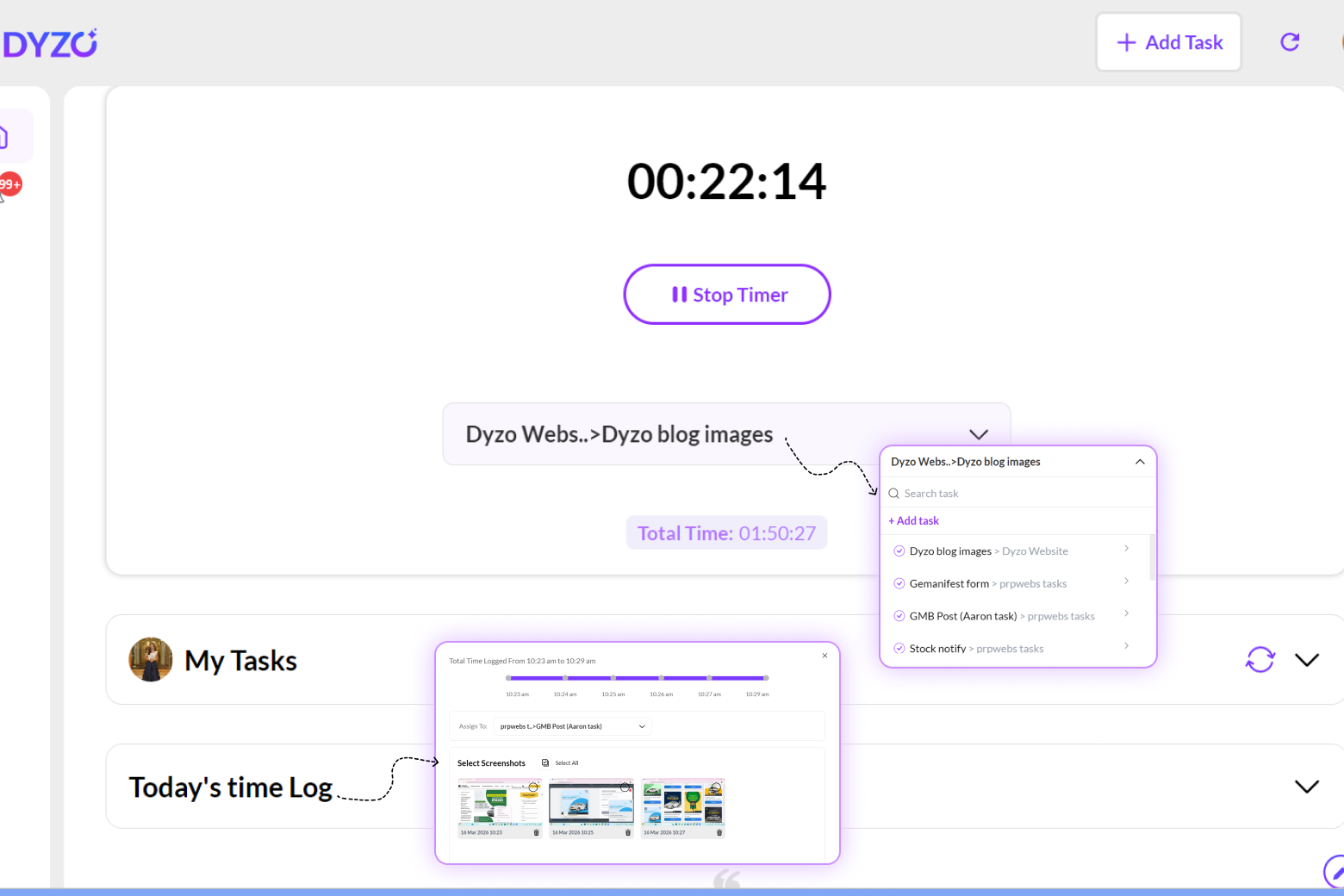
Modern platforms , including those built with AI-first principles like Dyzo.ai are moving toward automation to minimize friction and improve data reliability.
2. Primary Use Case: Define the Business Goal
Not all time tracking software serves the same purpose. Clarify your main objective:
- Payroll accuracy and compliance
- Client billing and invoicing
- Project cost tracking
- Productivity and capacity planning
The best employee time tracking software is the one that solves your most important problem first.
3. Essential Features to Look For
While requirements vary, strong solutions typically include:
- Advanced Reporting & Analytics Clear insights into time trends, utilization, and performance
- Invoicing & Billing Support Especially important for agencies and service-based businesses
- Integration Capabilities Seamless connection with accounting, HR systems, and project management software
- Mobile Accessibility Essential for remote, hybrid, and distributed teams
At Dyzo.ai, time data is treated as a core operational signal, not a standalone metric, which is why integrations and analytics matter more than raw tracking alone.
4. Team & Culture Fit
Adoption is just as important as functionality. Before choosing a tool, consider:
- Ease of onboarding
- Transparency vs employee trust
- Privacy and data controls
- Flexibility for global teams
Software that feels intrusive or complex often leads to poor adoption, regardless of how powerful it is.
Best Employee Time Tracking Software Compared (2026)
Before the framework, here’s a quick side-by-side of the most-used time tracking tools in 2026, with real pricing, free-tier limits, and whether they capture screenshots.
| Software | Free plan | Paid from (per user/mo) | Screenshots | Best for |
|---|---|---|---|---|
| Dyzo | Yes | ~$1 | Yes (optional) | Teams wanting time tracking + tasks + reporting in one tool |
| Toggl Track | Up to 5 users | $9 | No | Freelancers & small teams billing by the hour |
| Hubstaff | 1 user | $4.99 | Yes | Remote teams needing proof-of-work & payroll |
| Time Doctor | No (14-day trial) | $6.67 | Yes | Productivity monitoring for larger teams |
Pricing = lowest paid tier on annual billing, per user/month, as of 2026. Verify current rates on each vendor’s site.
Core Software Archetypes in the Market
Instead of focusing on individual tools, it’s more useful to understand the main types of employee time tracking software available today.
1. The All-in-One Platform Integrator
Best for: Scaling teams and growing businesses Focus: Unified operations and data flow These platforms embed time tracking within a broader operational ecosystem. Key features to prioritize:
- Native integration with project management software
- Centralized dashboards
- Cross-functional visibility
- Scalable user management
Typical pricing: Per-user or tiered subscription plans
2. The Freelancer & Small Team Specialist
Best for: Freelancers, consultants, and small agencies Focus: Simplicity and billing speed These tools emphasize ease of use and quick invoicing. Key features:
- Simple timers and manual entries
- Client-based reports
- Fast invoice creation
Typical pricing: Freemium or low-cost per-user plans
3. The Automated Productivity Suite
Best for: Knowledge workers and modern digital teams Focus: Automation and insights This category represents the shift toward intelligent time tracking. Key features:
- Automatic activity-based tracking
- Productivity trends and insights
- Minimal manual input
- AI-driven reporting
At Dyzo.ai, this shift toward automation reflects a broader industry trend: reducing employee effort while increasing management clarity. Typical pricing: Per-user plans with advanced analytics tiers
4. The Field & Operations Manager
Best for: Field services, logistics, and on-site teams Focus: Mobility and real-world tracking Designed for employees who work outside traditional offices. Key features:
- GPS-based tracking
- Mobile-first experience
- Shift scheduling and job costing
- Offline support
Typical pricing: Per-user or per-device models
Why Integration Determines Long-Term Value
Time tracking delivers maximum impact when it’s part of a connected system. When time data flows directly into task planning, reporting, and financial analysis, businesses gain real-time insight into performance and profitability. This is why modern solutions increasingly position time tracking alongside project management software rather than as a standalone tool. At Dyzo.ai, time tracking is viewed as one layer of a broader operational intelligence stack ,helping leaders move from tracking hours to understanding outcomes.
The Future of Employee Time Tracking
The future of the best employee time tracking software is not surveillance—it’s intelligence. Key trends shaping the space include:
- AI-powered automation replacing manual timers
- Predictive analytics for workforce planning
- Context-aware insights tied to business outcomes
- Stronger emphasis on trust, privacy, and employee experience
As work becomes more outcome-focused, time tracking will continue evolving into a strategic decision-support system.
Conclusion: Choosing the Best Fit for Your Business
There is no universal answer to which tool is “best.” The right employee time tracking software depends entirely on your team structure, goals, and operational complexity. By applying a strategic selection framework, focusing on tracking modes, use cases, features, and culture fit , businesses can make confident, future-ready decisions. At Dyzo.ai, we are passionate about how intelligent, AI-powered software transforms business operations. The evolution of time tracking toward automation, insight, and integration is a journey we are deeply committed to advancing, helping organizations gain clarity, efficiency, and control as they scale.
Ready to try Dyzo for free?
Plan work, track time, and automate busywork — all in one place.
Start Free with Dyzo →No credit card required · Free forever plan · 2-minute setup
Frequently asked questions
What is the best employee time tracking software in 2026?+
It depends on your goal. For an all-in-one tool that combines time tracking, tasks, and reporting, Dyzo starts at about $1/user/month with a free plan and optional screenshots. Toggl Track (from $9/user/month) is best for hourly billing, Hubstaff (from $4.99/user/month) for proof-of-work and payroll, and Time Doctor (from $6.67/user/month) for productivity monitoring.
Which time tracking software offers a free plan?+
Dyzo and Toggl Track both offer free plans — Dyzo's has no per-seat cap on core tracking, and Toggl Track's free tier covers up to 5 users. Hubstaff offers a free plan for a single user, while Time Doctor has no free plan (only a 14-day trial).
Does time tracking software with screenshots invade employee privacy?+
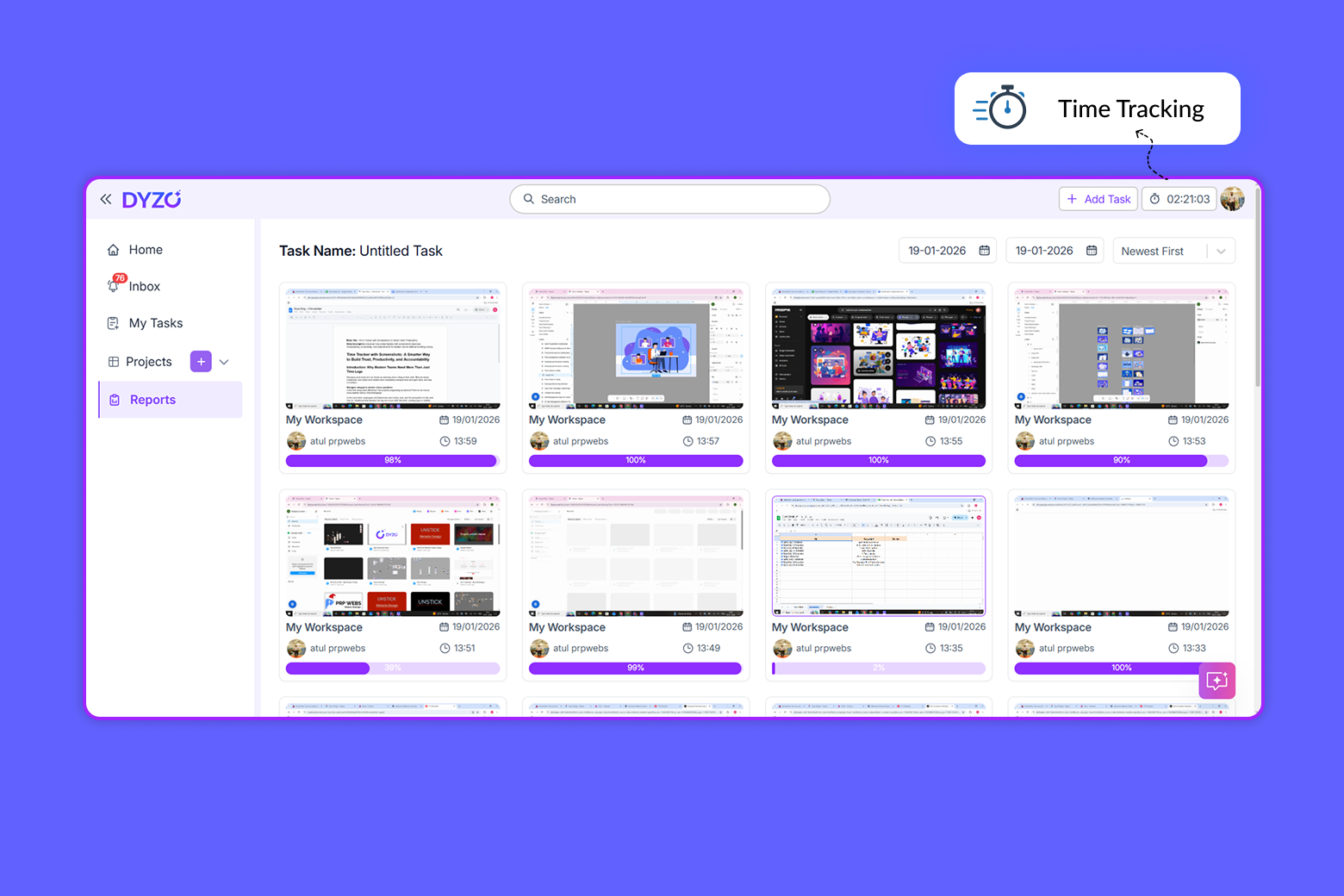
Not if it's configured transparently. Screenshots should be optional, disclosed to the team, and blurred where needed. Dyzo captures periodic screenshots only during active work sessions and shows exactly what's tracked, so accountability doesn't come at the cost of trust.
What time tracking software works best for remote and distributed teams?+
For teams spread across time zones, look for automatic tracking, activity/screenshot proof-of-work, and live reports that replace status meetings. Dyzo, Hubstaff, and Time Doctor all support remote accountability; Dyzo adds task management and time-zone-aware scheduling in the same platform.
Part of these guides: